
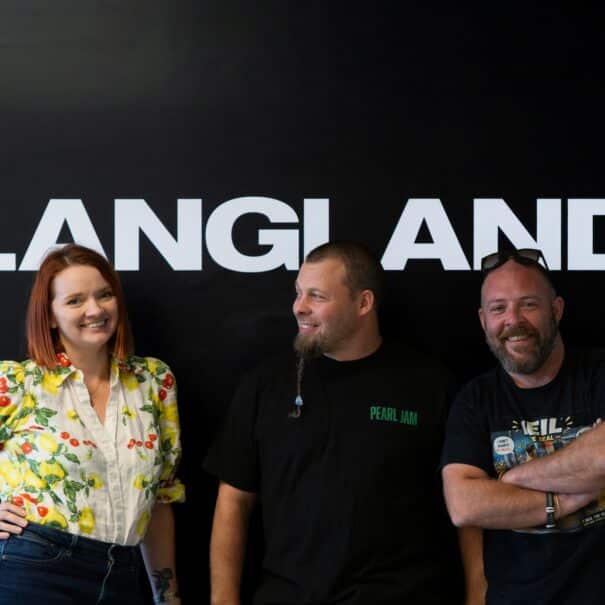
A Day in Strategy, Creative and Science at Langland, White City Innovation District
Langland is the agency that thinks further across every angle of health communications. Part of Publicis Health, and in turn Publicis Groupe – one of the world’s largest communications groups – the agency brings together scientists, strategists, creatives, production experts, medical writers and publicists to unlock ideas others might overlook.
From its White City home, Langland’s Advertising team helps pharma, biotech, public sector and charity organisations create brands that resonate, campaigns that capture attention and experiences that leave a lasting impression. Simple. Surprising. Empathetic. Their work is recognised on some of the industry’s biggest stages, from Cannes Lions to the Pharmaceutical Marketing Society Awards. Yet their focus remains on helping clients find fresh perspectives, translate complex science and deliver meaningful results for today’s healthcare challenges and tomorrow’s opportunities.
We caught up with Strategy Director Louis Glynn, Creative Director Michael Brightley, and Associate Director, Medical Copy, Steffi Evans, to learn more about the thinking behind the work – and why White City Innovation District continues to spark fresh perspectives.
Q1: What is a typical day like for you?
Louis: A typical day begins with a client challenge. Our role is to look beyond the brief to uncover the human and commercial truths behind it. From there, we devise solutions that not only help our clients grow but also resonate meaningfully with their audiences.
Michael: Much of my day is focused on defining what matters most strategically for individual clients. I work closely with our multidisciplinary teams – which include medical writers, designers, creative writers and art directors – to review the brief, develop ideas and ensure that we really understand why a potential concept works.
This work can lead to presenting a range of creative routes to clients, from video and experiential ideas to fully integrated campaign platforms. Later in the day, I might review created materials to ensure they strike the right balance between creative impact and scientific accuracy, alongside managing and mentoring my team.
We also devote time to producing case studies for new business pitches and award submissions, which are an important showcase for our work and reputation. Creative work is often the shop window, so clarity and engagement are essential.
Steffi: My team and I sit at the nexus of medical science, creativity and strategy. On any one day we can be taking clinical trial data and interpreting it through the lens of a brand’s strategy to create scientific content, or working with the creative team to develop and review the most exciting and meaningful ways to share that data.
Working in our industry you get exposure to lots of different areas of medicine. Over my career I’ve covered everything from radiology and medical imaging to surgical implants, cancer medicine, COVID, blood disorders, autoimmune conditions and more. We’re always at the front line of learning what’s new in medical science, and helping find ways to communicate that is really exciting.
Q2: What do you love about working in White City Innovation District and why did you choose to be located here?
Louis: We wanted to be amongst the energy of White City Innovation District. The sense of possibility here gives people in this building something to be excited about. This area encourages curiosity and pushes us to look beyond the obvious, for example, exploring deeper than the more well-known attractions like Westfield and the iconic heritage of the BBC, which was a big draw for us. It also reflects our fundamental mindset – there’s always more to discover if you go looking for it.
This spirit connects with how we think about creativity and keeps us from falling into lazy thinking and templates. In our industry, there’s always a risk of defaulting to formulaic thinking. This environment continually challenges us to do things differently. Being close to Imperial and the wider innovation district reminds us to keep looking for new ways of doing things, rather than repeating what has been done before.
Michael: For creatives, soaking up the culture around you is very important. White City offers that – whether it’s walking the backstreets, discovering new pop-up places to eat, or making the most of spaces like the Advanced Hackspace [Imperial’s prototyping hub and innovation community].
There’s also a strong sense of purpose here. Many people in healthcare want to make a difference, and White City Innovation District brings together diverse perspectives to make that possible. It has the potential to connect people and ideas that might not otherwise meet.
Steffi: For a lot of medical writers, our background is academia – so White City Innovation District is a nice little throwback to our days spent in labs running experiments! It’s a great reminder of the perseverance and incredible unique thinking that goes into making a medicine or healthcare device. I know when I was in a lab, it was hard to see the bigger picture when you might be studying a single protein – but seeing that detailed, focused work going on at White City Innovation District and the impact medicines make to patients in the real world is such an amazing full circle moment. It’s a reminder that every little thing we do – from the lab bench to the billboards – matters.
“We wanted to be amongst the energy of White City Innovation District. The sense of possibility here gives people in this building something to be excited about.”
Q3: What does ‘innovation’ mean to you, and how does your organisation contribute to it?
Louis: Innovation is about rethinking something familiar and achieving better results. It’s practical, not abstract. A good example is bio-inspired engineering – studying how cicadas naturally repel bacteria and exploring how that principle could be applied in hospital environments.
Michael: I think innovation operates at different levels. At its most transformative, it’s non-linear and a leap into something entirely new – bringing approaches into healthcare or pharma that haven’t been used before.
Prototyping is a big part of that: testing ideas that don’t yet exist in the market. That might mean using technology in completely new ways, such as predictive tools for relapses in conditions like multiple sclerosis.
Steffi: I think innovation is imagination with purpose. It’s looking at a problem with a completely unique viewpoint that only your lived experiences and brain can create and applying that in a way that nobody else can. We have so many people from different walks of life at our company. I work with people who are fiction writers, fashion enthusiasts, musicians, budding chefs, polyglots, actors, athletes, gamers, movie buffs, martial artists, activists… when we show up as ourselves then we have the beginnings of something really special, and a great platform to make something truly innovative.
Q4: What are you most proud of in your current role?
Michael: I’m particularly proud of the work we did with the UK mental health charity Mind, focused on reaching underserved communities. We recognised that mental health services don’t always reflect people’s lived experiences, cultures or communities.
The campaign aimed to change how Mind communicated – making it more authentic and relatable. The guiding idea was simple: if this speaks to you, speak to us.
Q5. What’s the best advice you have for people looking to break into your specialism?
Michael: I started as a copywriter and found my way into the industry almost by accident. For aspiring writers, my advice is to remember that good writing is often about editing – cutting what’s unnecessary and refining what remains.
Read your work aloud to ensure it sounds natural. Simplicity and clarity are powerful. And above all, listen carefully. Often, the answers are already there – your job is to recognise and articulate them.
Steffi: I actually started in account management, which is the team that helps coordinate work through an agency and takes care of client relationships and communications. It was really helpful for learning the ins and outs of agency life, but science was always in the back of my mind and eventually I made a horizontal move into medical writing. It really is a varied field, and the skills you need will vary from one area to another. If you’re really into your data and science, you might be better suited to a career in publications or medical education. But if you have creative flair, then medical advertising might be more up your alley. Having an idea of what kind of writing you want to do will help you narrow down your focus. But the key thing is to practice and get your work out there! Medical writing doesn’t just have to exist in congresses or journals or doctors’ offices – write a blog or start a channel on socials, or even just practice talking about science with people in your life.
Q6. What would Plan B have been on the career front?
Michael: Music was actually Plan A! I was a guitarist and vocalist in a rock band, touring across the UK and Europe. I still play and create music, and it remains an important creative outlet for me.
Louis: I’d be a pork butcher. It sounds like a complete left turn, but I’ve always loved the idea of taking something people see as ordinary and understanding it so deeply that you can transform it into something exceptional. A good butcher doesn’t just randomly cut meat. They understand every part of the animal, know what each cut can become, and find value where other people don’t (i.e. sausages).
Steffi: It’s hard to know. I was one of those kids that could never decide on what they wanted to be growing up! But there was always a science focus. I think at varying times I wanted to be a palaeontologist, a veterinarian, a zookeeper, a doctor, a forensic scientist, a marine biologist… I love nature and an adventure though, so I like to think maybe if I could do things over, I’d be some kind of ecological scientist doing field work, or a wildlife veterinarian.
Q7. What is the hot topic in your business?
Michael: AI is the dominant topic right now, and it’s pervasive. The challenge is staying informed, using it responsibly and ensuring it enhances creativity rather than replacing it.
At the same time, there are broader global shifts happening in pharma – particularly in the US and the growing influence of markets in the East. Changes in regulation, including FDA policies on vaccines and rules around advertising medicines to the public, could significantly reshape how the industry communicates.
Louis: The rise and rise of AI has fundamentally shifted where and how our audiences consume information about the disease areas and brands we represent. So, the way of doing communications strategy must also shift.
Communicating directly to a human, in a human way, is going nowhere but the world around it is increasingly more complex. Now we must also factor in how to write for machines to pick up what we are communicating to then serve it to humans.
Wherever you are on your journey – launching a brand, changing perceptions, tackling a complex communications challenge or perhaps exploring your next career move – connect with Michael, Louis and Steffi, or discover what Langland is thinking about next.