
White City innovators shaping the future of sustainable fashion
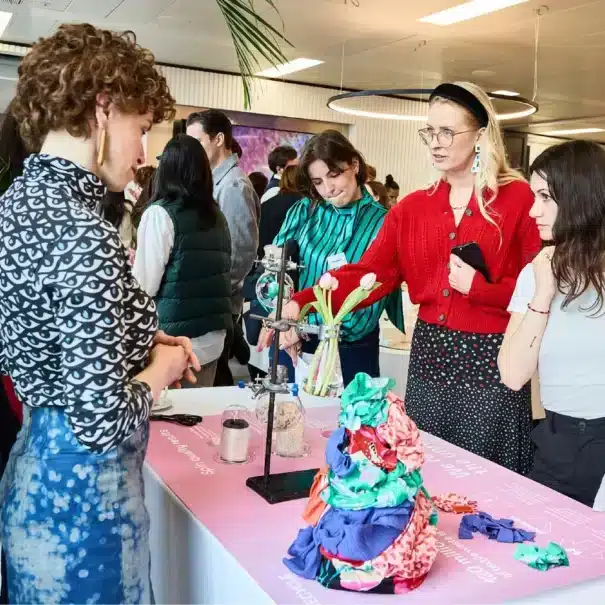
White City Innovation District played host to fashion leaders, investors and founders, plus eleven of the UK’s top innovators, for an exclusive showcase highlighting how the UK can lead a sustainable fashion revolution.
The sustainable fashion showcase, hosted at Imperial College London’s White City Campus in the heart of White City Innovation District, explored how to move cutting‑edge fashion and textile research out of the lab and into our wardrobes — and why long‑term investment and support to stay, scale and manufacture in the UK is the key.
Imperial Vice Provost Mary Ryan chaired contributions from an expert industry panel which included fashion designer Genaro Rivas, fashion investor Irene Maffini, Julian Ellis-Brown (CEO of Ponda), and James MacDonald (CEO of I-HUB-based Solena Materials).
White City Innovation District start-up Radiant Matter – based in Scale Space – was also showcased at the event, demonstrating its naturally shimmering biomaterials for use in apparel and the circular economy.

White City Innovation District is rapidly emerging as a leading hub for sustainable fashion innovation. Over the past five years, Imperial staff and students have launched an impressive 17 sustainable fashion startups and spinouts – many with support from Undaunted, the UK’s leading climate innovation community.
To help start-ups to stay and scale in the UK, Imperial last month launched a first‑of‑its‑kind pilot and demonstration facility – GraphtWorks – delivering advanced manufacturing capabilties. Part of the WestTech London innovation ecosystem, this new facility in West London is supporting Solena Materials to develop novel materials using computational design, and will also soon be home to Epoch Biodesign – a start-up harnessing breakthrough AI-engineered enzyme technology to recycle previously unrecyclable nylon textiles.
“We can reclaim Britain’s proud heritage in the textile industry by embracing frontier technologies that are both disruptive and sustainable. We’re entering an era where vats of bacteria can be designed to synthesise planet-friendly textiles, new chemical and biological tools are capable of breaking down existing fashion waste into the molecular building blocks for new materials, and CO2 is being removed from the atmosphere and turned back into valuable products. If we are smart about supporting the ecosystem all the way up the value chain then the UK economy can reap the benefits.”
Professor Mary Ryan, Professor of Materials Science and Vice Provost at Imperial College London